Clinical Psychology
Psychology Research Institute / PsyRes
Bridge between research and innovative therapy
Based on our belief that insight into the psychological and neurobiological underpinnings of psychopathology can inform assessment and treatment, our programme bridges fundamental research into learning & memory and clinical research into innovative psychotherapies (including Cognitive Behavioural Therapy, Schema Therapy, and Acceptance and Commitment Therapy), that capitalises on close collaboration with clinical practice.
Research topics
Specific current research topics include: emotional memory and treatment of anxiety disorders, an individual differences perspective on clinical assessment and treatment, forensic psychology, habit-based interventions, medical psychology, post-traumatic stress disorder, sleep, psychosis, self-injury, atypical development, and mindfulness.
-
Understanding the Dynamics of Suicide: An Agent-Based Modeling Approach to Inform Intervention Strategies in an Urban Context
- Valeria Epelbaum, Valeria Krzhizhanovskaya, Denny Borsboom, Derek de Beurs
- 2025-2028
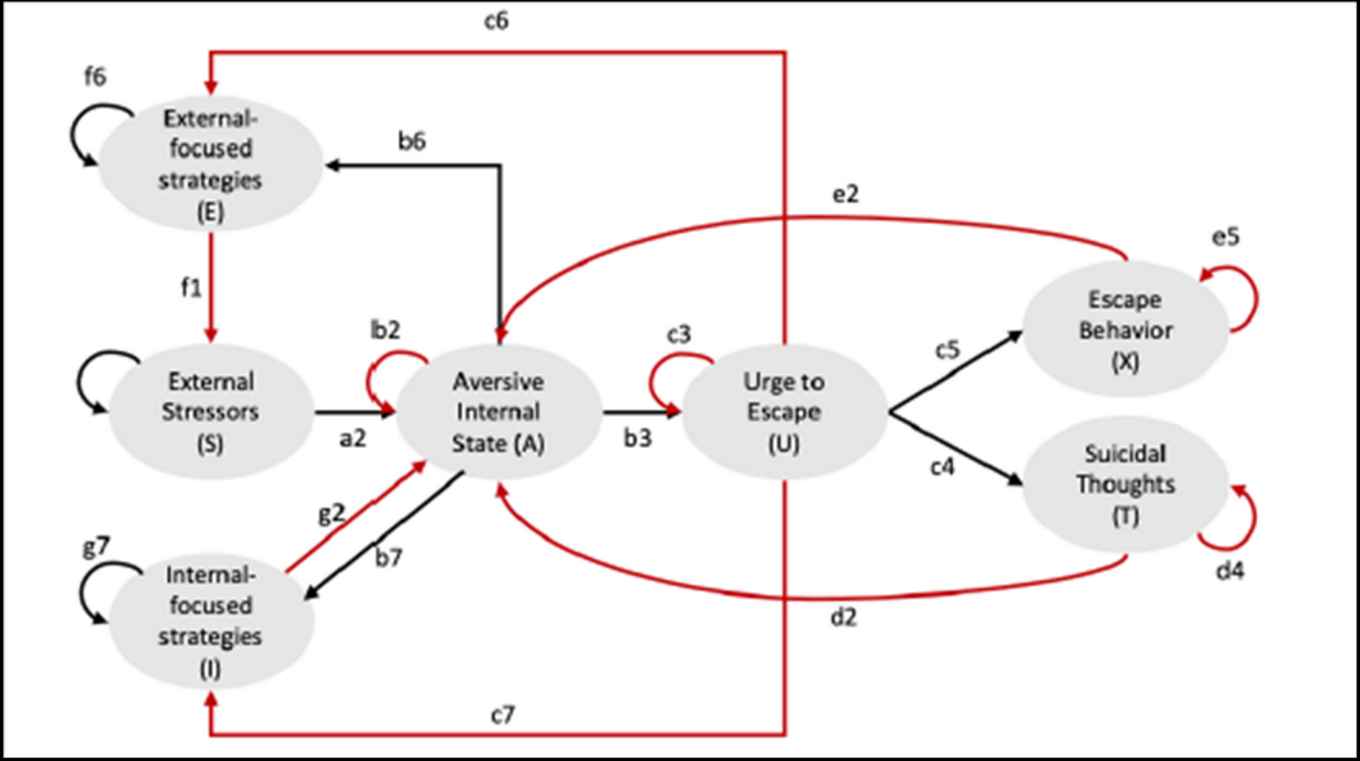
‘Suicide is a complex phenomena. In our project, we will develop computational models to explore the complexities of suicidal behaviour and transitions from thoughts to attempts. By formalizing existing psychological theories, we aim to simulate real-world scenarios and test the impact of interventions. These simulations can suggest more effective suicide prevention strategies, tailored to different urban environments and personal circumstances.
Funded by Urban Mental Health grant.
-
New Science of Mental Disorders
- Prof. dr. Merel Kindt, Dr. Renée Visser, Dr. Tessa Blanken, Dr. Marie Deserno
- 2020 - 2030
We share a new perspective on mental disorders that goes beyond the categories of the Diagnostic and Statistical Manual of Mental Disorders (DSM), which is by far the most widely used diagnostic tool for mental disorders. The DSM follows the medical model that assumes a deeper cause that could explain all the symptoms of a mental disorder. According to our model, the various symptoms that a person has constitute the actual disorder. By mapping these symptoms, as well as identifying how they interact with each other (influenced by behaviour, thoughts, brain activity and social relationships), we think we can develop better treatments. We believe that the network of symptoms that a person has is often transdiagnostic in nature, meaning that it usually does not necessarily fit within one particular diagnosis as it is currently defined in the DSM. Treatment should target this transdiagnostic network of symptoms, and this network is different for each individual. The ultimate goal of NSMD is to improve treatment of mental disorders.
Funded by NWO.
-
MIND-CHAT: May I help you? An Intervention for Non-suicidal self-injury and Depression through a culturally-sensitive Chatbot
- Nida Gizem Yilmaz, Tinne Buelens, Henk Cremers, Annemiek Linn, Ellen Smets
- 2024 - 2028
Dutch-Turkish and Dutch-Moroccan communities are the largest non-Western migrant groups in the Netherlands, with a substantial share living in major cities where ethnic minorities form the majority. These groups face disproportionately high rates of depression—15.1% in the first generation and 13.0% in the second, compared to 8.2% among native Dutch people. Depression is strongly linked to adverse outcomes such as non-suicidal self-injury (NSSI), which also occurs more frequently in migrant populations. Despite these inequalities, no culturally sensitive interventions exist that effectively support depression- or NSSI-related prevention and help-seeking in these communities.
The proposed research aims to develop a culturally tailored chatbot to promote positive attitudes and intentions toward preventive and help-seeking behaviors among three generations of Dutch-Turkish and Dutch-Moroccan people. Combining complexity science (e.g., causal loop diagrams) with user-centered design, the project will ensure that the chatbot reflects the values, beliefs, and needs of the target group and of psychologists. Four work packages guide the project: mapping effective chatbot characteristics and determinants of mental health behaviors (WP1); identifying user needs and creating a prototype (WP2); developing the final chatbot (WP3); and evaluating its usability, acceptance, and trust (WP4).
Funded by the Centre for Urban Mental Health.
-
Radicalisering en psychosociale problematiek: Beter begrijpen, beter ingrijpen
- Dr. B. Doosje, Dr. A.R. Feddes, Dr. H. Szekeres, Prof. Dr. Mr. B. Sizoo
- September 2024 - March 2025
This project aims to provide an overview of the available scientific knowledge about the role of psychosocial factors in the radicalization process. It also looks at the latest state of interventions in use. Finally, the cooperation between care-, security- and the social domain is considered, and recommendations are made for further professionalization. To this end, an analysis of the available scientific literature was conducted (theory), a systematic literature review was conducted on evaluations of interventions that counter radicalization (interventions), and focus groups and interviews were conducted with professionals from the care-, security- and social domain (practice).
Funded by WODC.
-
Understanding sensitive periods of cognitive development through developmental networks
- Dr. Marie Deserno
- 2024 - 2028
Why do some children’s developmental trajectories diverge while others stay on track? Cognitive development emerges from a dynamic network of interacting processes, yet most research has struggled to capture these interactions in ways that yield clear predictions about when interventions will have the greatest impact or how early differences cascade into later outcomes. In this VENI project, I explore these questions from three complementary angles. First, I examine longitudinal cohort data to chart how cognitive and social skills co-develop, revealing when and where atypical trajectories diverge. Second, I develop and examine formalized additions (based on existing theories of atypical cognition) to a model that formalizes how limited resources - such as time and cognitive capacity - shape developmental pathways, producing either mutually reinforcing growth or cascading difficulties. Third, I integrate clinical expertise to understand how practitioners perceive and act on differences in cross-domain couplings. Together, these approaches are aimed at bringing us closer to understanding sensitive periods of heightened plasticity and how to think about developmental system characteristics such as coupling and decoupling of cognitive skills.
Funded by NWO.
-
Memory in Motion – From Emotional Events to Life Stories
- Renée Visser (PI), Floris Tijhuis (PhD Candidate), Dora Gözükara (Post-doc)
- Duration: 5 years
How do memories work together to create the stories of our lives? While we know a lot about the processing of single events on the one hand, and autobiographical memory on the other, we do not have a research framework that connects the two phenomena, preventing a comprehensive understanding of one of the most fundamental human experiences. Importantly, we know little about the effects of time and emotion on the transformation of memory networks, which may be key to understanding and treating persistent mental health problems. This project develops a model for ever-evolving memory networks underlying our sense of self.
Funded by NWO.
-
Sleep well, sleep tight: Unravelling sleep restriction therapy to promote sleep health and well-being
- UvA: Jaap Lancee, Han van der Maas, Mona Klau
- Oxford: Simon Kyle
- Funding: NWO VI.Veni.231G.083
- September 2025 - Augusts 2029
Insomnia is one of the most common mental disorders and a transdiagnostic risk factor for psychological and physiological disorders. While sleep restriction therapy (SRT) offers an evidence-based behavioural treatment for insomnia, the mechanisms underpinning its effectiveness are poorly understood. Moreover, 50% does not fully benefit, highlighting the need for improvement. Despite many empirical studies, mathematical models of sleep regulation, and a theory on SRT, these exist largely separately. Consequently, progress in our understanding of what governs healthy sleep is stalled. By creating a formalised theory of SRT, I aim to integrate our empirical knowledge into a computational model to identify mechanisms and opportunities to improve treatment. I will first identify empirical phenomena of SRT in datasets. I will then develop a computational model building on mathematical models of sleep regulation, using the identified phenomena as validation benchmarks. Finally, I will match symptom profiles to formalized treatment components and test opportunities for precision medicine in a case series design. Building on novel developments in computational modelling and incorporating state-of-the-science knowledge on SRT, now is the time to formalise its mechanisms and take the next step in optimising treatment for one of the most common mental disorders to date.